Load Prediction
MMOGs simulate vast three-dimensional environments within which participating players,
usually in the order of hundreds of thousands, control one or a set of entities with certain
game-specific goals.
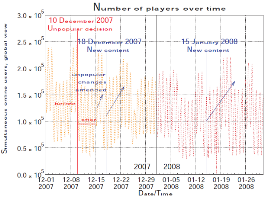 Unlike the typical web server applications which deal as well with
large numbers of concurrent requests, the load generated by MMOGs on the underlying infrastructure
is not strictly proportional to the number of connected users. Moreover, similarly to the
web server applications, the MMOGs allow users to join and leave the MMOG sessions at any time.
This introduces supplementary dynamism to the computational load the MMOGs generate.
Another particularity of the MMOGs, not encountered in other web applications, is that
they are real-time applications, which means that the correct functioning of the simulation
depends on the timely responses from the MMOG servers. Thus, the game play experience the
MMOG applications provide to the players is inversely proportional to the resource saturation.
These two main characteristics, their extremely dynamic generated load together with their
real-time nature, place MMOG within a special class of applications for which load management
is crucial for their good functioning.
Unlike the typical web server applications which deal as well with
large numbers of concurrent requests, the load generated by MMOGs on the underlying infrastructure
is not strictly proportional to the number of connected users. Moreover, similarly to the
web server applications, the MMOGs allow users to join and leave the MMOG sessions at any time.
This introduces supplementary dynamism to the computational load the MMOGs generate.
Another particularity of the MMOGs, not encountered in other web applications, is that
they are real-time applications, which means that the correct functioning of the simulation
depends on the timely responses from the MMOG servers. Thus, the game play experience the
MMOG applications provide to the players is inversely proportional to the resource saturation.
These two main characteristics, their extremely dynamic generated load together with their
real-time nature, place MMOG within a special class of applications for which load management
is crucial for their good functioning.
Currently, due to the dynamic and human behaviour induced nature of the MMOG load, operators attempt to limit the load rather than predict it and provision resources accordingly. This approach has two major negative implications: (1) the numbers of players within a session needs to be limited, to the discontentment of the clients, and (2) a significant quantity of resources is wasted during the off-peak hours.